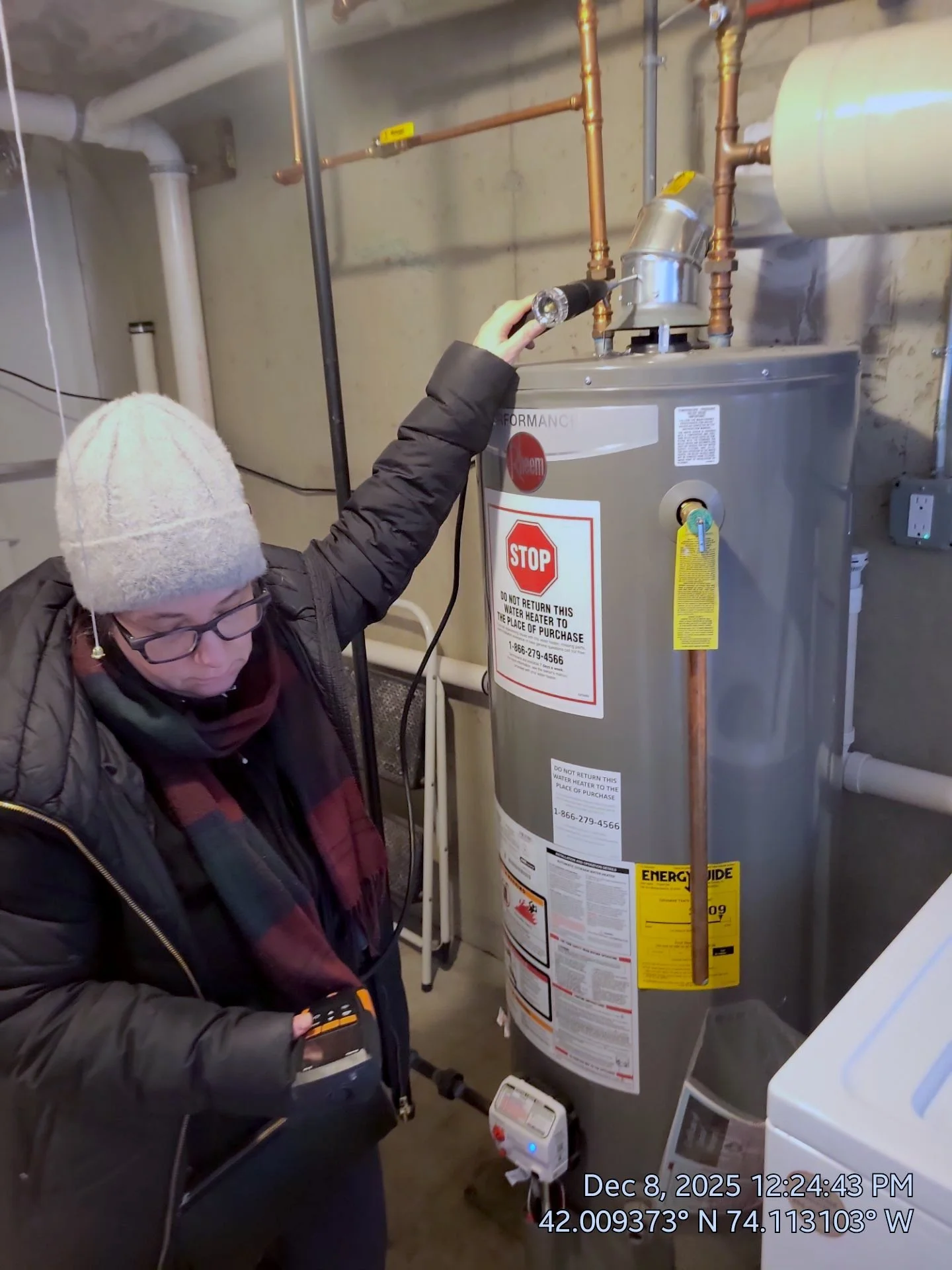
The Building Science Group partner Melinda McKnight using an infrared thermal imaging camera to detect heat loss during a home inspection.
SUMMARY / TLDR:
BSG performs all types of home inspections (buyer, pre-listing, maintenance, new construction), but every one is grounded in building science, not just a visual walkthrough
Building science investigates why a problem is happening, not just that it exists, tracing symptoms like condensation or cold rooms back to their actual root cause
Diagnostic tools like infrared imaging, blower door testing, combustion analysis, and moisture meters catch issues a standard visual inspection would miss entirely
Real cases include ice forming inside walls, acetone off-gassing from trapped moisture, and carbon monoxide risks from code-violating vent placement, all invisible to the naked eye
Unlike most inspectors, BSG doesn’t stop at the report: they develop a scope of work, review contractor proposals, and verify the fix was actually done correctly
Available for buyers, sellers, homeowners, and new construction across the Hudson Valley, NY, NJ, CT, and MA
The Building Science Group performs home inspections. Pre-listing inspections, buyer inspections, new construction reviews, maintenance inspections, all of it. But there's something that makes every inspection we do fundamentally different from what most homeowners have experienced before: we're building scientists first.
That distinction matters more than it might seem. And if you've ever walked away from a home inspection with a report full of visible findings but no real explanation of why those problems exist or what's likely to happen next, you already know why.
What building science actually means
Building science is the application of physics, chemistry, and thermodynamics to understand how heat, air, and moisture move through a structure. It treats your home not as a collection of separate systems: roof, HVAC, insulation, and windows, but as a single, interconnected organism where every element affects every other element.
When we inspect a home, we don't just ask "what do I see?" We ask "why is this happening, and where is it actually coming from?"
That question changes everything. A standard inspection might flag condensation on a window as a moisture issue. A building scientist investigates why that condensation is forming and might discover that the real culprit is an unsealed electrical box in the wall cavity creating a pressure imbalance, or a bathroom exhaust fan venting into the attic instead of outdoors. The condensation is a symptom. The cause is somewhere else entirely. Finding that cause is what building science is designed to do.
A deeper diagnostic toolbox
When we perform a home inspection, we bring capabilities that go well beyond what a standard inspection involves.
Infrared thermal imaging lets us see inside your walls without opening them revealing missing insulation, hidden moisture intrusion, and thermal weak points that are quietly driving up energy costs and creating conditions for future damage. Blower door testing measures the exact airtightness of your home's envelope, quantifying where air is escaping or entering and what that means for comfort, efficiency, and indoor air quality. Combustion analysis tests your heating equipment for safety. Moisture meters and borescopes let us investigate suspect areas with precision rather than guesswork.
These tools don't replace the careful visual inspection that every good home inspector performs. They add a layer of scientific evidence that makes the findings more complete, more accurate, and more useful to you as a buyer, seller, or homeowner making important decisions.
What we find that others miss
We've found ice forming inside bedroom walls from improperly framed windows. We've traced chronic health symptoms to acetone off-gassing from a vapor barrier trapping moisture against a wood floor. We've identified carbon monoxide risks from water heater vents terminating outside bedroom windows in violation of building code. In each case, the problem was invisible to the naked eye and would have passed a standard visual inspection without a flag.
None of this is meant to suggest that standard home inspectors aren't skilled professionals, many are. But the scope of a standard inspection is defined by what can be seen and observed visually. Building science extends that scope into what can be measured, tested, and scientifically analyzed. For many homes, especially older ones, that extension is the difference between knowing what a house looks like and knowing how it actually performs.
We don't walk away after the report
Perhaps the most meaningful difference between our inspections and a standard inspection isn't the tools we use or the credentials we hold, it's what happens after we hand over the report.
Most inspections end there. You get a document, you review the findings, and you're on your own to figure out what to do next. We work differently. When we identify a problem, we develop a detailed scope of work explaining exactly what needs to be done and why. We can review competing contractor proposals to help you understand what you're being sold. And when the remediation is complete, we come back to verify that the work was done correctly, that the materials specified were actually installed, and the methods prescribed were actually followed.
That final verification step is something most homeowners don't know to ask for. Once you understand it, it's hard to imagine settling for less.
The right inspection for every situation
We offer the full range of residential inspection services: buyer inspections for those purchasing a home, pre-listing inspections for sellers who want to know what they're working with before going to market, maintenance inspections for homeowners who want to stay ahead of problems, and new construction inspections to verify that a newly built home was executed to the standard it was sold on.
In every case, the building science foundation comes with it. You're not just getting a checklist. You're getting seventeen years of diagnostic experience, applied science, and a team that stays involved until your home is actually better.
Your building has answers. We find them.
If you're buying, selling, or simply want to understand your home more deeply, we'd love to talk. The Building Science Group serves homeowners, buyers, and sellers across the Hudson Valley, New York, New Jersey, Connecticut, and Massachusetts.
To schedule an inspection or learn more, fill out our short Contact Form or call/text 845-338-3864.